
3 3
Tainui Group Holdings
Annual Report
2012
Freight solutions vital to NZ
economy
When people think of the New Zealand Transport
Agency (NZTA), they probably associate it with
managing state highways, providing public transport
subsidies, and along with the Police, helping reduce
the road toll.
But it’s also responsible for long-term planning of –
and investment in – our major road networks. That has
implications for TGH’s proposed Ruakura development.
The stakes are high. NZTA spends $8.7 billion every
three years, at a rate of about $50 million a week.
In the last three years it has spent $1.6 billion in the
Waikato and Bay of Plenty.
Near the epicentre of all this is Harry Wilson. He’s
NZTA’s Regional Director for the Waikato and Bay of
Plenty. He also has a national responsibility around
freight effciency.
“What we want to do is make sensible investment
decisions. That means we need to understand the
whole long-range land use story in the upper North
Island. It’s not just about Future Proof, though that does
feed into our thinking,” he says.
“We have to be careful we don’t make the wrong
investment choices. Take for example the high cost of
trucking goods over the Kaimai ranges. One option
is to put a tunnel through, but that might cost up to
$2 billion. Another is to do what Kiwirail have done.
By adding just one turning loop, they’ve been able to
signifcantly lift the carrying capacity of the East Coast
rail line, and at a cost of only $9 million.”
Wilson says that from a freight perspective, NZTA has
to be agnostic about mode, and is equally interested
in shipping, ports and rail.
“The holy grail of freight effciency is full trucks, full
trains and full ships.”
Need
New Zealand, especially the upper North Island, is
currently some way off that.
“The export equation we have is low value, high
volume goods. The import equation is consumption
in Auckland. Between those two, there’s a whole story
to write. The emergence of KiwiRail as a long-haul
operator will change things if it works out. If KiwiRail
can get your product up and down the main trunk,
100% of the time, on time, you’ll get a shift from long-
haul road to long-haul rail.”
“And having KiwiRail as a reliable partner enables
long-haul transport operators to move from long-haul
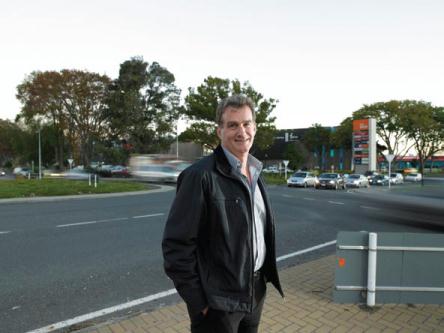
HarryWilson – NZTA Regional Director,
Waikato and Bay of Plenty.
trucks, and start to run bespoke confgurations. That will
start to suit inland port hubbing.”
In this area, the key aim for NZTA is effciency.
“We’re very clear that our priority is reducing the freight
cost of getting goods to market. We’re not trying to do
all things for all people. We’re trying to support the New
Zealand economy.”
Co-ordinationvital
But while NZTA is a big investor, it’s not going to dictate
what happens.
“We’re providing the road, but it’s the market which
determines who drives over it. We’re not trying to tell the
private sector what it can or cannot do. We’re trying to
work out where we can add value to that conversation. My
role is to make sure all the stakeholders in the region are
connected, and that everyone has good information.”
One result is the multi-region ‘Upper North Island
Strategic Alliance’ which has made transport one of its
top priorities. “The playing feld has become a stadium.
Instead of just having regional interests, everyone is
starting to see the power to grow the New Zealand
economy by joining together.”
Ruakura
Wilson explains that these changes have had implications
for Ruakura, as it has had to shift into a much wider
political and planning environment. He says however
that while the planning decisions have yet to be made,
Ruakura’s strategic advantage is the road and rail
combination and location between the Ports of Auckland
and Hamilton.
“Of course the NZTA can’t pick winners. The market
will dictate where inland ports and hubs are located but
Hamilton is a really good location strategically, given the
shortage of business land in Auckland, capacity issues,
congestion and so on. The critical thing is to stop thinking
about Auckland’s interest to grow Auckland’s economy,
but about the North Island’s interest to grow the New
Zealand economy.”