

3 2
Forward thinking the key to
managing growth
Growth is a huge issue in the upper North Island. Just
take these three projections:
The Waikato is already our fourth most populous
•
region. Along with Auckland and the Bay of
Plenty, it’s growing at a faster rate than the rest of
the country. Only 20 years from now, the ‘golden
triangle’ will contain over half the country’s total
population.
Today, the three regions generate 45% of our GDP.
•
In 15 years’ time that will be over 50%.
The rail link between Hamilton and Tauranga
•
carries more freight per kilometre than anywhere
else in New Zealand. Freight generated from the
Waikato will double in volume in 20 years, creating
huge future pressure on rail and trucking services.
In an effort to grapple with these challenges, all the
region’s Councils, Waikato-Tainui and the New Zealand
Transport Agency (NZTA) drafted a plan called ‘Future
Proof.’ It acts as a broad blueprint for development,
providing guidance for each Council in their own area.
Launched in 2009, Future Proof was timely given the
reviews of the Waikato Regional Plan and Hamilton
City’s District Plan, both underway this year.
Scopewidened
Ken Tremaine is a consultant to Future Proof. He
has many years of experience in this kind of work,
including the SmartGrowth project for the Bay of
Plenty. He says Future Proof has now widened its
scope to include the whole of the upper North Island,
given the huge inter-dependencies between each of
the three regions.
“The economies of Waikato and Auckland are
inextricably tied up with things like minerals, water
and freight. As Auckland grows, there are lots of
challenges. The Waikato needs to be seen as a
corridor of transport and land use between Auckland
and Hamilton. What goes where, and when, is actually
quite important. We have to get our heads around
what life will be like in 30 years.”
And growth isn’t the only issue, according to Tremaine.
“It costs as much to move a container from New
Plymouth to Auckland as it does to ship it to China.
With the rise of middle class markets in Asia, we
need to get exports to port very effciently, or we’ll
lose international competiveness. So there’s a real
imperative to address that.”
Timely infrastructure challenge
Tremaine says there are challenges to overcome.
“As a country, we struggle to get timely infrastructure
in place. Unlike say Australia with its state
governments, central government here has preferred
to leave it to regions and the market to sort out.”
“Having said that, since the Government via NZTA
is kicking in over $2 billion in transport projects for
the Waikato, they naturally want some certainty from
Councils in the area about the long-term plan.
Tremaine sees TGH’s proposed inland port and freight
hub at Ruakura as a vitally important step in tackling
both the growth and cost issues.
“Opportunities like Ruakura only come along once
in every 50 years, where you’ve got a market need,
a willing developer and huge economic benefts that
can be generated from putting a high-tech intermodal
freight terminal there.”
“You’ve also got a large chunk of land in the hands of
one organisation, which is rare. It’s normally hard to
get landowners to co-operate, and to think long-term,
and TGH is intergenerational in its thinking. Their
CEO was Container Terminal Manager for the Port of
Tauranga and a senior manager for NZ Dairy Group,
so there’s a heap of practical skill there.”
Important decisions imminent
Tremaine says the key tasks with Ruakura are to get
the regulatory framework right, identify the funding,
get alignment between land uses and make it an
economic proposition to develop. The Regional Plan is
the most critical component of this he says.
“Decisions like Ruakura are very important. We
will be competing with others, if we aren’t already.
Singapore is already the northern Asia-Pacifc hub,
and Brisbane is a contender for the southern one
alongside Tauranga.
“Not only that, but unless we get good inland facilities
and critical mass in distribution, then the southern part
of Auckland will end up pressuring the food bowls of
the city.You only have to look at the Hutt Valley and
large parts of Christchurch to see what happens when
you put motorways over food bowls.”
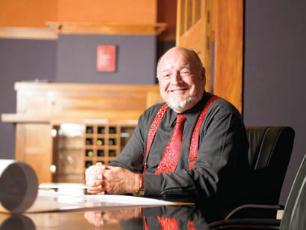
Ken Tremaine – consultant to Future Proof.