2 0
Ruakura
As I mentioned earlier, we determined that
envisioning what Ruakura could truly become was
going to be the key to a really special and successful
development.
This has involved considering the scope of activity,
what technologies could be deployed there, and what
different models we could use. To this end, we built
on our 2011 visits to several US and Australian inland
ports by engaging expert advisors with extensive
international expertise.
It is the right sequencing and aggregation of linkages
between ourselves as landowner, ports, transport
operators and infrastructure providers, tenants and
their customers that is the key to Ruakura achieving
the potential it is capable of.
Everything will grow around the inland port and the
technology employed there. For export and import
customers, visibility of their goods and access to them
are the keys. So Ruakura will need both state-of-the-art
terminal management systems as well as the latest in
equipment to physically move goods on and off and
around the site. Total co-ordination will be required with
roading authorities, Kiwirail and the logistics community.
What we are now working on is the role TGH could play
over time. We are clear that we will employ the same
approach used at
where key partnerships
were established at various stages. This means
there will be huge opportunities for others to join us
in the Ruakura development, and that it will attract
considerable external investment into the Waikato.
We also know that it will have humble beginnings, and
will be a carefully staged development. If Ruakura
obtains all the necessary regulatory approvals, the
project will start with one or two initial anchor tenants.
We will establish all the necessary infrastructure
and access to enable them to locate and operate as
effciently as possible.
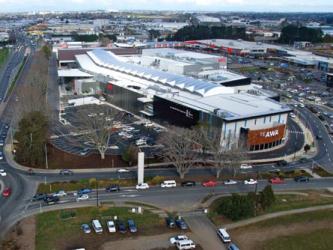
For the remaining stages of development at
we secured all resource consents during the year except
for the hotel and one other large format retail site.
We also continued to develop the master plan for
those remaining stages, working out what would be
the next best step to take. This work has been made
easier by our purchase of the one hectare property on
the corner of Te Kowhai and Te Rapa Roads, a parcel
of land within the area that the tribe did not own.
Given the ongoing positive customer response to
access, egress and parking were a big focus for
us in 2012.
We completed all underground parking under
extended the parking areas at
entrance, and created a new staff parking area
(important given that over 1,500 people work there).
We created a new mid point access to
, which
opened in Easter 2012, and signalisation of the Base
Parade will take place this coming fnancial year.
Our commitment to resolving traffc issues with
the Hamilton City Council builds on signifcant
expenditure by TGH made in earlier years. The two
lanes that used to be State Highway One running past
for example, were expanded to four lanes in
2007, three years ahead of schedule, courtesy of TGH.
While they enabled traffc to move more freely, they
have been well used.
In that respect, the new Te Rapa by-pass, which will
be complete by the end of 2012, will be a major
step forward. It will provide an alternative route for
traffc heading north from the western side of the city,
decongesting Te Rapa Road where it passes in front of
.
We have determined that the next addition to
will be an ‘auto precinct,’ providing a range of vehicle
services. These are likely to include a valet service, a
tyre service, muffer and brake workshops,WOF, and
so on. Customers coming to
r
can
shop, eat or go to the movies while their cars are being
attended to. The precinct will match the rest of
for the highest standards of quality.
The precinct will be located next to Heathcotes.
Foundations will be laid by the end of 2012, and we
expect it to be open for business around the end of
the frst quarter of 2013.
The Base