

1 0
“Although we sold out in 2012
to help fnance the
hotel, we
maintain close ties with
and are always on
the look-out for other co-
investments.”
The
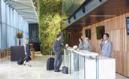
hotel wasn’t specifcally in
TGH’s strategic plan, though
it had looked at potential
hotel developments. It came
about unexpectedly through
pre-existing relationships
with
and Auckland
International Airport, but it was
defnitely an opportunity worth
checking out. “Airport hotels
are a very sound commercial
investment. Auckland had
none on its campus, and with
a 70% share, we got an added
boost to our future cashfows,”
says Pohio.
“Equally importantly, along
with
, it entrenched
our reputation for creating
top quality assets,” he
says, “and reinforced our
commitment to refecting
Waikato-Tainui ownership
in our developments. The
hotel, which has since won
2011
Construction of
stage 3 commences
tage 1 & 2 opens
$50m debt facility with
signed increasing
debt capacity to $200m
2012
opens
Sale of shares in
Huntington development
nears completion
tage 3 & 4 opens
regional and national design
and architectural awards, is a
showcase of New Zealand’s
rich cultural heritage.”
The
again
featured as a commercial
partner in a TGH-led hotel
development, and was a good
example of TGH’s approach to
joint-venturing. “The reality is
that we don’t want to fnance
everything ourselves, even if
we could. And more than that,
it recognises that each party
brings different skills to the
table,” he says.
TGH has developed close
working relationships with
a range of professional
advisors as well. These
include: architects
and
property development
project managers
engineers
construction
company
law
frm
auditors
fnancial advisors
and public affairs advisors
Partnerships will again be
to the fore in the inland port
and freight hub at Ruakura.
All these developments have
brought a higher public
profle, and from 2006, TGH
started to come out of its
shell. Up till then, it had been
a case of proving by doing.
What changed was a survey
the company did back then of
public attitudes. “There were
many misconceptions, and
a lot of negativity. It showed
we had to get out there more
and tell people what we were
doing, and by then we had a
good story to tell.”
Those efforts in recent years
have included an annual event
at which the company’s results
are presented to community
leaders, councils, the business
community and Members of
Parliament. They have also
seen the publication of an
enhanced annual report, one
that the New Zealand Institute
of Chartered Accountants
recognised as a fnalist in
the main category of their
2011 Annual Report Awards.
In recent years it has been
augmented with a special
shareholder supplement that
provides further details on the
fnancial results. TGH’s website
has also had a refresh to make
it more user-friendly.
Behind the scenes, the
company puts a lot of effort
into shareholder consultation
via an annual strategic
planning session with Te
Arataura, the tribal executive,
and regular presentations to
the tribal
Parliament. The Chairman and
CEO also have regular contact
with the Te Arataura Chair on
day to day matters.
Spencer and Pohio have
observed more than one
sea change in the past few
years in attitudes toward
the company. “The tribe
are certainly pleased with
what’s been achieved, and I
think the wider community
has now accepted that what
happened in the early days
after the settlement is well
and truly in the past,”says
Spencer. “More recently too,
people have moved past the
idea that we’re some kind
of threat.” The fnal stages
of The Base were famously
blocked in late 2009 by what
was known as ‘Variation 21.’ It
was overturned by the High
Court, and following the 2010
local body elections, the issues
were successfully resolved
by face to face negotiation.
“We now have a real sense
that Hamilton and the Waikato
see TGH as part and parcel of
their future.”
“Our track record shows
that we’re here for the long
term. We’re big investors
in the local economy. We’re
into partnerships. We value
long-term relationships. And
Ruakura is potentially the
biggest future driver of the
Waikato economy,” says Pohio.
For John Spencer, these kinds
of initiatives mean that iwi-
owned investors are going
to be a crucial part of New
Zealand’s economy in the
years to come.
One myth he still does want
to dispel though is that
Waikato-Tainui, and Ngai Tahu,
are ‘rich.’ “Take the annual
dividend and divide it by
60,000 members of the tribe.
It’s a few hundred dollars each.
And if you liquidated TGH
tomorrow – sold everything,
paid off the loans – each
person would get a one-off
cheque of about $6,000. So
there’s a long way to go yet,
but the trick is to stay positive
and to keep looking for what’s
possible.”