
9
Tainui Group Holdings
Annual Report
2012
Planning for
commences
2007
Construction of
otel
commences
$30m debt facility with
established
2009
Partial selldown
of managed funds
investments
Construction at
stage 1 commences
Construction of
large format retail ends
2010
Full selldown of managed
funds investments
Construction at
hotel
commences
Planning for Ruakura
commences
Construction of
stage 2 commences
$50m debt facility with
established
Debt facility with
is increased to $100m
That quality came not just from
attention to detail. “Both
nd
re hugely
complex equations”, says
Pohio. “It included selection
of the right tenants, their
placement in relation to each
other, their infrastructure
and support needs, and the
management of everything
from security to waste to
maintenance.”
as partially fnanced
by a new $50 million debt
facility, this time from the
Spencer says the signing
of this agreement was very
signifcant: the
had
written off a loan in the early
years. Having them back was
a very special moment, and
another important milestone.
In 2008 the company
liquidated its managed funds,
and these proceeds were
also earmarked for
along with a new opportunity.
TGH and
Corporation had signed a
co-investment agreement, and
the chance to jointly purchase
shares in
came up. TGH bought 4.5% of
Ryman. “We very much saw
it as a way to consummate
the relationship,” says Pohio.
under its self-imposed 30%
limit, and that by now all its
properties were insulated by
either strategic value or solid
tenancies.
Nevertheless, as the Global
Financial Crisis (GFC) hit,
TGH postponed most planned
developments save
Planning for
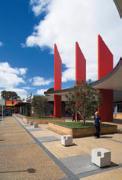
the mall,
was underway, and in 2008
Spencer says the company
made “its biggest-ever call,
to proceed with this new
development despite the
ongoing impact of the GFC.”
The Board however issued
a caveat: 80% of tenancies
had to be signed up before
construction could begin on
each stage of development.
Farmers Trading became the
anchor tenant and construction
commenced in January 2009.
Pohio says that achieving this
in a market where no-one
else could attract tenants was
an absolute turning point for
the company. “What swung
it was prospective tenants’
understanding of what TGH
was capable of, and what
ould mean for their
competitive position.”
“For perhaps the frst time,
the penny dropped that TGH
was a property investor, not a
property developer. In other
words, we weren’t going to
build this fagship asset and
then fick it on in six months,”
says Spencer. “Tenants saw
that we were fexible in
meeting their individual needs,
and we had a real commitment
to quality.”
2004
2003
$M
0
2
4
6
10
8
12
2012
2011
2010
2009
2008
2007
2006
2005
11.0
10
10.5
10.5
10.7
7.4
5.5
3.4
0.0
10
21
%
0
%
35
%
46
%
68
%
57
%
84
%
64
%
70
%
53
%
Dividend
Dividend
% of NPAT
Annual dividend
(TGH andWTF)
2004
(excluding
)
Farms and other investment property
Hamilton CBD properties
Callum Brae Tanui
2003
$M
0
20
40
60
80
100
120
2012
2011
2010
2009
2008
2007
2006
2005
Capital Expenditure
(TGH)
2008
pens
Purchase of shares in
for $37m
$14m of shares in
received
50% of
acquired
from the joint venture
partners, TheWarehouse
Group